
I want to be fair in my portrayal of Leadership and how I communicate concerns and opportunities within Leadership. I want to propose solutions in addition to observations. In my series “It’s Not What they Say” I focused on Diversity, Equity, and Inclusion (DEI). My main takeaway there was that if the folks that are pushing this agenda cannot find a way to better filter their nominations for high positions, or enact a progressive training regimen… they will brand themselves as inefficient and ineffective.

There are so many disclaimers that need to be applied in this area of discussion. Let me be clear – there is no biological advantage of one over another to find success within a position except in terms of “Disabled”, injured, handicapped, etc. Race and Biological Sex do not determine someone’s ability to run a company or manage a team. Having a superior base in the work that leads up to those positions may.
As an outsider looking in, the DEI initiatives seem to focus so hard on the recruitment of sex and color that they are willing to broad-jump the foundations of qualification. When that happens, it is a poor result for all involved.
- The Candidate is flushed out as a fraud.
- The Company suffers loss in position production, HR expense, and possible litigation
- The DEI Practitioner suffers a poor reflection of judgment
- The concept of DEI becomes more controversial and begins to bolster the concepts it is trying to eradicate
As an author in leadership and corporate trainer, I want as many people as possible to experience their potential for success. It takes work, time in service, dedication, networking, and a commitment to continually improve. Now years into a DEI cycle, I am seeing more and more public posts such as these. (Please read all of it — Contact and original poster’s name removed)
We’re in 2023 and I don’t like that that this is a reality, but people (including leadership) still don’t know what DEI in the workplace truly entails. This lack of knowledge leads to unrealistic expectations placed on the DEI practitioner, which eventually leads to burnout, and it’s also why people think that DEI “doesn’t work.”
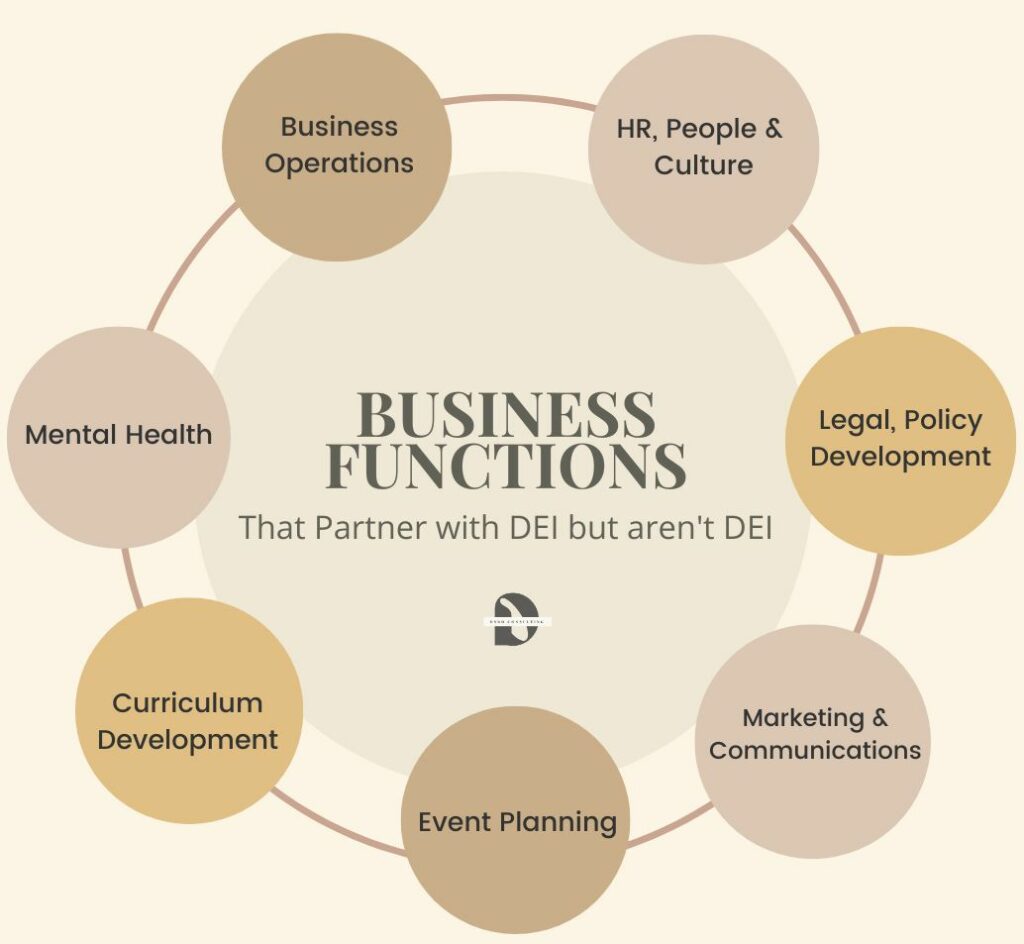
In the graphic below, I identify the top 8 business functions that I see being added to DEI practitioners’ plates that should NOT be a part of a DEI practitioner’s job. Let’s talk about my top 3:
? Mental Health: DEI practitioners can partner with mental health professionals to provide support for employees but should not be the emotional dumping ground for employees.
? HR, People & Culture: DEI practitioners can collaborate with HR to create equitable recruiting and hiring practices but should not be leading those efforts. Recruiting & Hiring is one small branch of HR and Culture and doesn’t encompass the entire DEI across a company.
? Marketing and Communications: DEI practitioners can partner with marketing & comms teams to ensure equitable messaging. However, they are not experts in cultivating a brand voice and creating marketing/communications material that aligns with the brand.
Companies need to identify what their real needs are and hire specific roles that align with those needs. Hiring a DEI manager or director is not a catch-all role that oversees the things that no one else wants to deal with.
Lastly, DEI practitioners must set healthy boundaries by sticking to their job responsibilities to avoid burnout and level-set expectations.
So What is the Job?
So here we see a list of 8 things the DEI Practitioner believes is not on their list. However, if I were to read it more closely, it reads more like they believe the company should hire experts in these specialties so that the DEI Practitioner can tell them what they need. This premise by itself flies in the face of business culture.

Business tends to think in terms of Assets and Liabilities. When they launch a new position it is generally launched in a blended form to see if it gains traction and has the potential to become an Asset. From a business perspective, new hires especially those from additional pathways of experience, are going to require deeper onboarding and training. It would make complete sense to blend DEI responsibilities with Curriculum Development.
Marketing? Again, from an outside-looking-in standpoint… DEI is a marketing tactic and tool. Companies are bending over backward by employing DEI Practitioners, promoting that hire in forms of media, and curbing their marketing to be more inclusive. When a practitioner positions themselves as an expert in the targeted inclusion demographic… by extension, they would be assumed to have a possible role in Marketing.
The post above states two things that strike me. 1. People think DEI isn’t working. 2. DEI Practitioners are trying to distance themselves from the tools that require the work to make DEI succeed.
Corporate Positions have a sense of being in flux at many companies. They grow, reduce, blend, and here’s the kicker… need to morph to fit the needs of the company. DEI needs to be more than leveraging the people in other positions to attract the people of your targeted demographic. Further… for companies that promote that they actively endorse DEI, they eliminate a great deal of talent from applying.
If these are the things that DEI doesn’t want to do and they are afraid of burn out… what do they want to do? there has to be action tied to the salary.
Observation to Solution
While onlookers may want to view a company from the outside and say it’s not diverse. What core reasons are there that may drive that result? Wasn’t it Jordan Petersen that boldly asked in an interview “If 99% of bricklayers are male, why aren’t we putting a quota on female bricklayers?”. This extends to many fields. If a person serves in the foundational, manual labor portion of an industry and works their way up to management… it is not the “Privilege” that gained the result… it is the work. Many would argue that it would be “Privilege” to skip the time in service and foundational work steps needed to be confident in the position.
How do we fix this? I believe we extend grace and patience to the matter. This is not a lightswitch cultural repair. Things like Politeness, timeliness, and Professionalism are not signs of “Whiteness”. (Remember Coca-Cola in the news?) They are indications of a stature of position that comes from dedication and a hunger to succeed on one’s merit.
Meritocracy in itself cannot be a bad thing. Hiring someone that can demonstrate efficiency and effectiveness in a position sounds like a great plan. Paying someone more because they can produce more, again seems to sound like a great plan.

So then culturally, at a grassroots level, what is keeping all of the people groups from participating at every level of employment and working their way to the top? If it feels like the ones at the top are a majority of one group, but then analysis shows that they also had the advantage and willingness of time in service and opportunity to do the founding work, the results properly reflect the ingredients. So let’s work at getting all people groups plugged in with foundational work that leads to a graduated ladder of success.
This takes action over complaining. This requires our social structures to embrace work and study which leads to a progressive path of growth. Indoctrination of a “victim mentality” needs to be replaced with confidence in foundational knowledge and skill. This is not lost on the white male either. As our school systems have pulled back on the trades and attempted to focus on ideas over labor. We have disadvantaged all of our young people… except the ones that pushed through the ruse.
Think of the Confidence
Ability breeds confidence. Think of the confidence that comes with accomplishment. Being knowledgeable about how to change a tire on your car, add software to a computer, fix a dripping faucet, or lube a hinge to stop a squeaky door may seem basic — but it is foundational in societal confidence. People that seem to know how to read a map and compass display natural confidence on the trail and on hikes. What about confidence in the work force?
In my own practical experience, I think of the Service Manager that never worked on cars, the Marketing Director that is not creative, the Training Manager that has not developed a curriculum, and the speaker that has not prepared or honed their craft. In all these cases and with no relation to sex or race… the failure was lack of preparedness, lack of foundational work, and a propping up into a position that was not warranted.
Bypassing the hard work and showing up unprepared is doing nobody a favor. Now, everything I just wrote by no means says that other people groups aren’t qualified. What I am pointing out is that typical DEI Practitioners are so focused on the outcome they seek (% of group hired) that they are shortcutting the qualification, onboarding, and training portion of the job. Then when it fails, they want to say “Those 8 things aren’t in my wheelhouse and I need to draw boundaries in order to avoid burnout”.
High Paying, High Profile jobs take extreme effort and carry a lot of weight. Yes, it’s a burden. Leadership is a burden and a privilege to execute.
